
3 game-changing fitness insights to cut churn and boost profits
The health and fitness landscape is evolving at breakneck speed—and the best way to thrive is to transform with the market. That’s where Butter’s latest data report comes in.
We zoomed in on the fitness and health industry to equip subscription leaders with insights they can use to develop more effective payment recovery strategies and maximize profits. You can also use our research to tee up conversations with colleagues and peers at this year's Connected Health & Fitness.
However, before we jump into the findings, it’s essential to understand the foundation of our analysis. This report compares the health and fitness vertical against all other industries, using the latter as a baseline. Data used to generate the report is a snapshot of Butter’s total transaction data from 2025.
Without further ado, here are three payment recovery insights and actionable strategies to solve them.

1. Fitness brands are leaving millions on the table

Like all industries, the health and fitness industry suffers from failed payments.
Our analysis showed that for every million subscribers, the industry could lose as much as $6 million in revenue on a monthly basis and $76 million on an annual basis.
To put this into perspective, a fitness merchant with 50,000 subscribers could be losing up to $318,000 in revenue monthly or $3.8 million annually.
How do you solve your failed payment problem? Partnering with an AI-powered recovery solution is the most effective strategy to minimize revenue loss. When evaluating a platform, focus on these elements:
- Big data: AI lives and breathes on data, and the more a model has access to, the better it will perform. Look for a partner who’s been active in the space for several years and has a massive dataset to draw from.
- A holistic approach: It’s not retries versus outreach—it’s both. Partner with a platform that coordinates both recovery and outreach. Not only will you maximize recovery, but you’ll also prevent unnecessary customer touches.
- Predictive signaling: You need to know more than your recovery rate to optimize recovery. Evaluate platforms that use predictive signaling to identify which failed payments are most likely to be recovered, allowing you to prioritize high-value opportunities.
How MasterClass recovered 27% more revenue with Butter

2. Collecting a backup card supercharges recovery
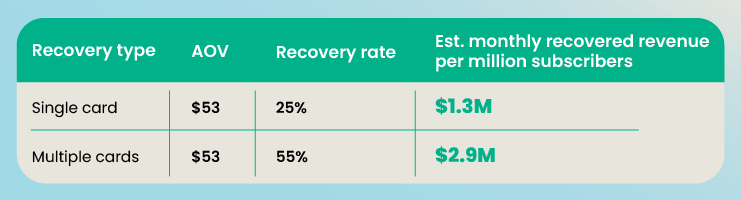
Collecting a backup card is an easy way to recover more revenue. Our analysis shows that failed payments for fitness subscribers with multiple cards on file are more than twice as likely to be recovered as those with a single card. Compared head-to-head, that’s a $1.6 million difference between a single card versus a multi-card strategy.
But what does this translate to for an individual subscription company? A fitness brand with 50,000 subscribers could increase their monthly recovered revenue by about $800,000 by switching to a multi-card strategy–a $9.5 million boost to ARR.
Tactics you can use to encourage subscribers to add a backup include:
- Require subscribers to add a second payment method at sign-up.
- Offer an incentive like swag, sample products, early access to products, or reduced shipping.
- Prompt subscribers to add a second card in your subscription management portal after they enroll.
- Require additional payment methods after the first failed transaction.
Regardless of the approach you use, focus your messaging on how having multiple cards on file improves your customers' shopping experience and reduces the likelihood of an interruption.
The Athletic drives millions in recovered revenue with Butter

3. Insufficient funds are a bigger problem than you realize
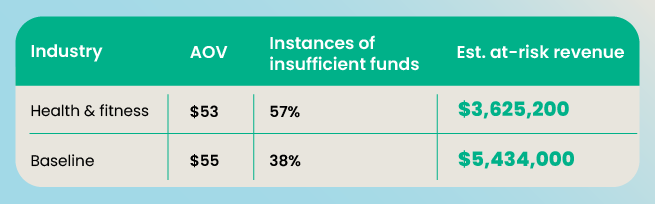
While insufficient funds are a challenge for all subscription industries, it’s an even bigger issue for the fitness space. The fitness industry experiences as many as 50% more instances of insufficient funds than the baseline. This translates to a loss of $3.6 million in revenue monthly per million subscribers and about $44 million annually.
On a practical level, a fitness merchant with 50,000 subscribers could lose $180,000 annually due to insufficient funds alone.
There are several strategies you can use to solve insufficient funds:
- Don’t accept prepaid cards. Prepaid cards are designed for limited use, unlike a debit or credit card, and will fail. It’s just a matter of time.
- Collect a backup card. The presence of a backup card is the single most predictive factor for recovery success.
- Offer multiple charge dates. Let your customer choose the date they’ll be charged for your service.
- Retry transactions on specific days. Re-run failed transactions on specific days when you believe your subscribers are most likely to be paid. For example, retry transactions on Mondays and Tuesdays for weekend workers.
Final thoughts
To thrive in 2026, fitness merchants need to prioritize reducing revenue loss from failed payments. This means adopting AI-powered recovery solutions, promoting backup card collection, and addressing the challenges of insufficient funds head-on. By implementing these strategies, you can protect your bottom line and keep your subscribers happy.
3 bold payments predictions for 2026

Your customers deserve Butter
Featured Resources

3 game-changing fitness insights to cut churn and boost profits

Understanding involuntary churn: a complete guide

5 data-driven strategies to maximize revenue this shopping season